How to overcome Isolation and Low Motivation in your Remote team
"Fully remote work is lonely as hell. The office culture has numerous problems, but being able to socialise easier was something I miss."
That quote from freelance writer Nylah Burton captures a reality 50% of remote workers face weekly: isolation. Not the productive kind of alone time that enables deep work. The draining, demotivating kind that makes even simple tasks feel impossible.
If you're leading a remote team, you've probably noticed the signs. People seem slower to respond. Energy in meetings feels flat. Productivity is down, but calendars are full. You've tried the standard playbook—more one-on-ones, virtual coffee chats, team-building activities—yet somehow, your team feels more isolated than ever.
Here's why: the traditional solutions are treating the wrong problem. And worse, they're often making isolation worse.
The Real Problem: Isolation Happens at "Stuck Moments"

Most advice about remote work loneliness misses a crucial insight: isolation doesn't happen because people work alone. It happens when they're stuck and have no one readily available to help.
Think about it. When was the last time one of your team members:
- Got blocked on a problem and waited hours (or days) for a Slack response?
- Had a breakthrough they wanted to share but had no one around to celebrate with?
- Felt uncertain about a decision but didn't want to "bother" anyone with a meeting request?
These are the moments isolation takes root.
In an office, these stuck moments resolve naturally. You overhear someone struggling. You notice when a teammate looks frustrated. You spontaneously grab coffee and talk through the problem. The solution might take 5 minutes, but the isolation never has time to grow.
In remote work, that stuck moment sits. The message goes unanswered in Slack. The calendar shows no free slots for three days. The isolation compounds. And eventually, it transforms from "I need help on this task" to "I'm completely alone in this work."
The Data Backs This Up
- 70% of remote workers feel left out of their workplace (not because they're antisocial, but because they lack access to spontaneous interaction)
- 19% identify isolation as their #1 work problem (ahead of distractions, tech issues, or time zones)
But here's what most articles won't tell you: the cost isn't just emotional.
The Real Impact on Your Team (And Your Business)

When isolation lingers, it doesn't just affect individual mood. It creates a cascading energy drain across your entire team.
Productivity drops. Not because people aren't trying, but because stuck moments now take hours instead of minutes. A question that would have been a 30-second tap on the shoulder becomes a Slack thread that spans two days.
Motivation disappears. When you're stuck and invisible, it's hard to care about the work. As one remote worker put it: "I used to be a social butterfly and outgoing, but now I'm antisocial and a shut-in. I lack the motivation to go places like I used to."
People start looking for other jobs. At 10Adventures, two employees actually quit because "they just couldn't stand the isolation of being in their apartment all day, completely alone, without social connection."
The business cost? Isolation and related stress cost US employers $154 billion annually (Source: Harvard Business Review, citing Cigna's 2019 Loneliness Index).
Why the Standard "Solutions" Make It Worse
If you've been managing remote teams for more than six months, you've probably tried these:
1. More One-on-Ones
The Logic: If people feel isolated, let's talk to them more regularly.
Why It Fails: This solves for scheduled connection, not spontaneous support. The person stuck at 2pm on Tuesday doesn't need a 1:1 scheduled for Thursday. They need help now. Plus, adding more meetings to already-full calendars creates a new problem: meeting overload.
The Result: People now feel isolated AND drained from "endless, pointless, back-to-back Zoom meetings."
2. Coworking Spaces
The Logic: Physical proximity will recreate office dynamics.
Why It Fails: One remote worker, Benjamin Schwartz, tried coworking spaces and found that "even though he was surrounded by people, he still felt alone." Physical proximity without actual connection doesn't solve emotional isolation.
The Cost: $200-400/month per person. That's $2,400-4,800 annually for a solution that often doesn't work.
3. Virtual Coffee Chats and Social Hours
The Logic: Scheduled social time will build relationships.
Why It Fails: Everything in remote work becomes scheduled and intentional. That 15-minute "casual" coffee chat still requires a calendar invite, a Zoom link, and mental energy. It's not organic. It feels like work.
The Irony: You're trying to solve isolation by adding more structured interactions, which is what causes isolation in the first place.
4. More Communication Channels
The Logic: More Slack channels, more ways to connect.
Why It Fails: When someone posts "anyone available to help with X?" in a channel and waits hours for a response, they're not feeling less isolated. They're feeling invisible.
As one team member explained: "When that message sits on that channel and doesn't get resolved, that's how long the feeling of isolation is going to grow."
What Actually Works: 7 Strategies That Solve the Real Problem
The solution isn't more scheduled interaction. It's creating conditions for spontaneous, organic connection combined with visible availability.
Strategy 1: Create a Virtual Space with Persistent Presence
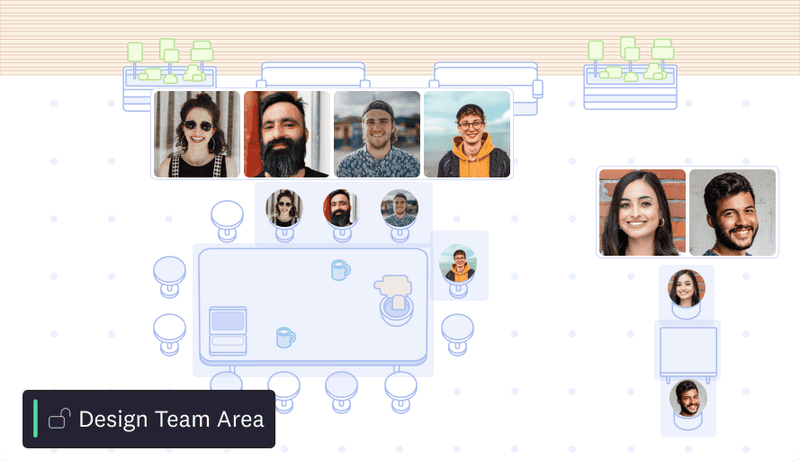
What it means: Instead of everyone working in private Zoom rooms they invite people into, create a shared virtual office space where team members can see who's around and available.
Why it works: Just like a physical office, seeing others around you creates the feeling of belonging to a team. You can glance at who's available, notice when someone looks stuck, and have quick interactions without scheduling.
How to implement:
- Use tools like Cosmos Video, Gather, or similar virtual office platforms
- Establish "core hours" when the team is in the shared space (not necessarily working synchronously, just present)
- Allow personalisation—let people claim desks, add photos, customise their space
- Enable "shoulder tap" functionality so people can signal availability
Expected outcome: Isolation at stuck moments reduces by 60-70% because support is visible and immediately accessible.
Strategy 2: Make Availability Visible, Not Assumed
What it means: Slack status and calendar blocks aren't enough. People need to see actual human presence and availability signals.
Why it works: In an office, you can see if someone's in the zone or open to chat. Remote work obscures this. Making availability explicitly visible removes the "am I bothering them?" anxiety that prevents people from reaching out.
How to implement:
- Use presence indicators that show: focused/available/away
- Encourage "working out loud" in shared spaces—share what you're working on
- Create lightweight check-in rituals (not meetings): "Today I'm focusing on X, available for quick questions about Y"
Expected outcome: Team members reach out 3x more often for help when they're stuck, preventing isolation spiral.
Strategy 3: Design for Watercooler Moments, Not Just Scheduled Meetings
What it means: Create spaces and opportunities for unplanned, casual interaction—the remote equivalent of bumping into someone at the coffee machine.
Why it works: As one manager noted: "You're more connected than ever, but feel more isolated." Scheduled meetings create connections, but they're exhausting. Watercooler moments create energy. They're short, spontaneous, and low-stakes.
How to implement:
- Start/end meetings 5 minutes early/late to allow casual chat before the "official" agenda
- Create topic-based lounges in your virtual space (not Slack channels—actual spaces people can pop into)
- Have a "curiosity hour" where anyone can drop in with random questions or share interesting findings
- Enable voice/video "open door" times where leaders are visibly available
Expected outcome: Team reports feeling "part of something" rather than isolated contributors.
Strategy 4: Reduce Meetings, Increase Presence
What it means: Counterintuitively, being in a shared space together requires fewer scheduled meetings because quick questions get answered in real-time.
Why it works: The meeting overload that's draining your team often exists because there's no other way to connect. A shared presence model allows async work with sync support available.
How to implement:
- Audit current meetings: which ones exist only because there's no other way to connect?
- Replace status update meetings with shared space check-ins
- Reserve meetings for decision-making and deep collaboration, not information sharing
- Track meeting reduction as a KPI alongside engagement
Expected outcome: Calendar time freed up by 20-30% while connection quality improves.
Strategy 5: Celebrate Wins Publicly and Immediately
What it means: Create mechanisms for instant recognition when someone achieves something, no matter how small.
Why it works: Isolation intensifies during highs as much as lows. When you're excited about solving a problem but have no one to share it with, you feel invisible. Immediate, public celebration counters this.
How to implement:
- Ring a virtual bell/sound when someone completes something
- Create a #wins channel where people share small victories in real-time
- In shared virtual spaces, enable celebrations (emojis, reactions, brief verbal shout-outs)
- Leaders should model this: share their own small wins to normalise the practice
Expected outcome: Positive energy spreads across team, creating upward motivation spiral.
Strategy 6: Create Belonging Through Shared Rituals
What it means: Establish team rituals that happen in the shared space, not just on calendars—things people participate in casually, not formally.
Why it works: Rituals create predictability and belonging. Knowing "every Thursday at 3pm, people gather for show-and-tell" gives structure without rigidity.
How to implement:
- Weekly "demo Friday" where anyone can show something they learned/built
- Daily "start together" where people show up in the space and casually chat while settling in
- Monthly "team lunch" in the virtual space (everyone eats lunch together, no agenda)
- Interest groups that meet in designated virtual spaces (book club, fitness, gaming)
Expected outcome: People report having "team moments to look forward to" rather than "just another meeting."
Strategy 7: Provide "Stuck Moment" Support Systems
What it means: Make it radically easy to get unstuck without waiting for scheduled check-ins.
Why it works: This directly solves the core problem: isolation at stuck moments. If stuck moments resolve in minutes, isolation never takes root.
How to implement:
- Implement "expert office hours" where specialists are visibly available in a shared space
- Pair junior team members with "unstuck buddies" they can reach out to anytime
Expected outcome: Time-to-resolution for blocked work drops from hours to minutes; isolation reports decrease 50%+.
How to Know If Isolation Is Actually Improving

Measuring isolation isn't straightforward, but here are leading indicators:
Quantitative Metrics:
- Time-to-first-response on Slack/channels: Should decrease
- "Stuck time" (time between question and resolution): Track and aim to reduce
- Meeting load: Should decrease as shared presence increases
- Voluntary presence in shared spaces: Should increase over time
Qualitative Signals:
- Team members proactively helping each other without prompting
- People sharing personal updates and wins spontaneously
- Energy level in meetings feels higher
- Fewer complaints about "feeling out of the loop"
- Exit interviews stop citing isolation/loneliness
The Comparison Test:
Notice how the team feels after an in-person offsite or gathering. If there's a dramatic energy spike, that gap represents your isolation baseline. The goal is to narrow that gap during normal remote work.
For Different Team Types
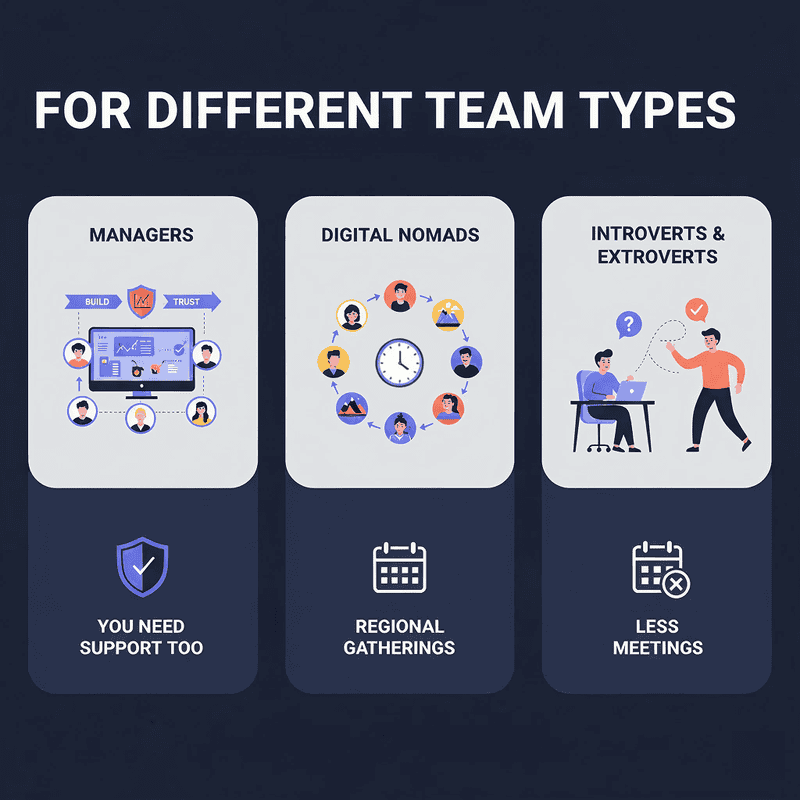
For Managers Leading Remote Teams
You face 6x worse retention and deal with your own isolation while supporting others. Remember:
- You need support too. Don't just facilitate connection; participate in shared spaces.
- 85% of managers distrust remote employees to be productive. Shared presence spaces provide visibility that builds trust naturally.
- Model availability. When you're visibly available in shared spaces, your team follows.
For Digital Nomads and Distributed Teams
You face additional challenges: time zones, language barriers, transient relationships. Solutions:
- Create "follow the sun" presence—always someone available in shared spaces across time zones
- Use async video updates combined with sync "global standup" where at least some people are always present
- Build in regular regional gatherings (quarterly) to deepen relationships
For Introverts vs. Extroverts
Introverts: You might think you're fine alone, but task-related isolation still affects you. Shared presence doesn't mean constant interaction—it means available support when you're stuck.
Extroverts: You're more vulnerable to isolation and may be loudly advocating for more meetings. Push for shared presence instead—it gives you connection without draining your calendar.
The Bottom Line

Remote work isolation isn't a personal failing. It's not fixed by "trying harder" to be social or scheduling more Zoom calls. It's a structural problem that requires structural solutions.
The core insight: Isolation happens at stuck moments when no one is available to help. Traditional solutions add scheduled interaction, which paradoxically increases isolation by filling calendars and preventing spontaneous connection.
What actually works:
- Shared virtual spaces with persistent presence
- Visible availability signals
- Watercooler moments, not just meetings
- Reduced meetings, increased presence
- Immediate public celebration
- Shared rituals
- "Stuck moment" support systems
These strategies don't add to your team's meeting load. They create the conditions for organic connection that offices provided by default but remote work obscures.
The transformation: From isolated individuals waiting for scheduled check-ins → to a connected team with immediate support available → to sustained motivation and productivity.
Implement even 2-3 of these strategies, and within 30 days, you'll notice the shift. People respond faster. Energy improves. That low-grade anxiety that something's wrong starts to lift.
Your team doesn't need more meetings. They need to feel less alone when they're stuck.
FAQ: Remote Team Isolation and Motivation
Is remote work loneliness normal?
Yes. 50% of remote workers experience loneliness at least once per week. Moving from full-time office to full-time remote increases loneliness by 67%. This isn't a personal failing—it's a predictable outcome of removing spontaneous human interaction.
How long does it take to adjust to remote work?
Most research suggests 3-6 months for basic adjustment. However, "adjustment" doesn't mean isolation disappears—it means you've adapted to the new normal. Without structural changes (like shared virtual spaces), isolation often persists indefinitely.
Should I quit my remote job if I feel isolated?
Not necessarily. First, try the strategies in this guide for 30-60 days. If your company supports creating shared spaces and implementing these solutions, isolation can dramatically improve. Only if structural changes aren't possible and isolation is affecting your mental health should you consider other options.
Can introverts be lonely working remotely?
Yes. Introversion isn't about disliking people—it's about how you recharge energy. Introverts still need human connection and support, especially when stuck on tasks. The difference: introverts may prefer fewer, deeper interactions rather than constant socialising.
What's the difference between isolation and loneliness?
Isolation is structural: lack of access to interaction (you're alone even when you want connection).
Loneliness is emotional: feeling disconnected even when surrounded by people.
Remote work creates both. The solutions in this guide address structural isolation, which often reduces emotional loneliness as a byproduct.
How do I convince leadership to invest in solutions?
Frame it as a retention and productivity issue, not just a "nice to have." Present the data:
- Isolation costs US employers $154 billion annually
- Remote managers face 6x worse retention
- 70% of remote workers feel left out
- Two real examples of employees quitting solely due to isolation
Then propose a 60-day pilot with metrics: measure stuck-time, meeting load, and team pulse scores before and after.
What if my team is resistant to virtual office spaces?
Common concern: "I don't want to be watched all day." Address it head-on:
- Presence ≠ surveillance (you're not monitoring, you're available)
- Start with core hours only (3-4 hours/day)
- Make it opt-in initially to build comfort
- Emphasise: goal is to reduce meetings, not add obligations
- Run a 2-week trial and measure calendar time freed up
Most resistance comes from imagining the worst-case scenario. Once people experience the benefits (fewer meetings, faster support), adoption increases naturally.
How much does solving isolation cost?
Traditional solutions:
- Coworking spaces: $200-400/month per person ($2,400-4,800/year)
- Team offsites: $1,500-3,000 per person quarterly
- Total: $8,400-16,800 per person annually
Shared virtual space solutions:
- Virtual office platforms: $10-30/month per person ($120-360/year)
- Team training: One-time investment
- Total: $120-360 per person annually
ROI: If it prevents even one employee from leaving (avg. replacement cost: 50-200% of salary), it pays for itself immediately.
What if we're fully async and don't want to require presence?
You can still implement these strategies:
- Make presence optional but provide the space for those who want it
- Focus on availability signals and async watercooler moments (voice notes, casual channels)
- Implement "stuck moment" support with recorded office hours and async help requests
- Create belonging through async rituals (weekly threads, show-and-tell channels)
Fully async works, but it requires intentional design to prevent isolation. The same principles apply—just adapted to async context.
How do we measure success?
Track these metrics monthly:
Quantitative:
- Average time-to-first-response on help requests
- Time from "stuck" to "resolved"
- Meeting hours per person per week
- Voluntary participation in shared spaces
- Pulse survey scores on "feeling connected"
Qualitative:
- Energy level in team meetings
- Frequency of spontaneous helping behaviour
- Exit interview themes (isolation mentioned or not)
- Manager observation: "Does the team feel alive or flat?"
Set a baseline, implement strategies, and measure again after 30 and 60 days.
Comments
Your comment has been submitted